Why Is My Washer Not Draining in Abilene?
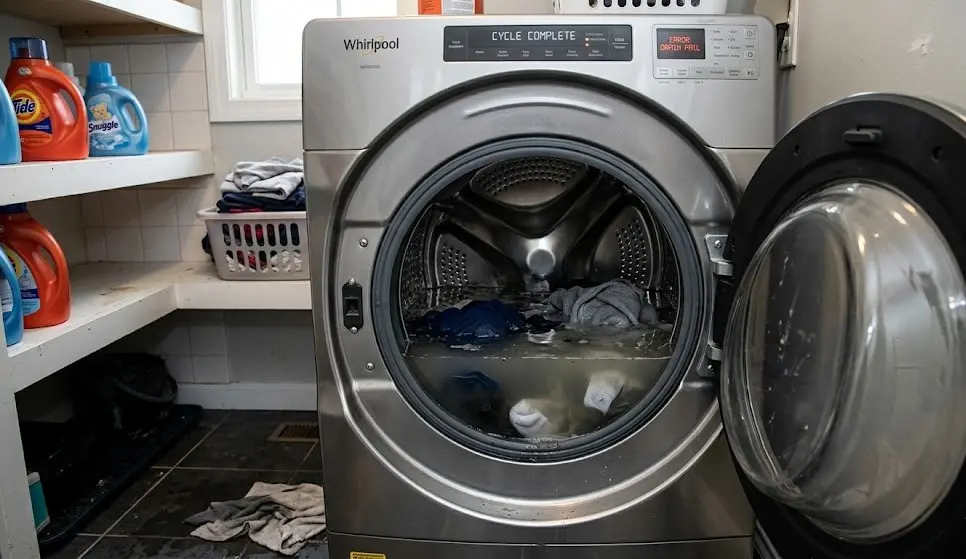
If your washer is not draining water in Abilene, the most likely cause is a clogged drain pump or blocked drain hose. Abilene’s notoriously hard water accelerates mineral buildup inside drain components, which combines with lint, coins, and small clothing items to block water flow.
Other common culprits include a faulty lid switch (on top-load washers), a kinked drain hose behind the unit, or a failed pump motor. In most cases, a qualified local appliance repair technician can diagnose and fix the problem during a single same-day visit, with repair costs typically ranging from $90 to $275 for standard drainage issues.
Why Abilene Homeowners Deal With This Problem More Than You'd Think
Living in the Big Country comes with a lot of perks, but your washing machine is not always one of them. Abilene’s water supply is notoriously hard, meaning it carries elevated levels of calcium, magnesium, and other dissolved minerals. Over time, those minerals coat the inside of your drain hose, clog the pump filter, and wear down inlet valves faster than they would in softer-water cities.
Add in the fact that West Texas heat pushes laundry cycles into overdrive — especially for families near Dyess Air Force Base dealing with piles of work uniforms, or households with kids coming home muddy from the parks around Kirby Lake — and you have a machine that gets worked harder and wears out faster than the manufacturer’s warranty suggests.
The result? A standing pool of soapy water sitting in your drum after the cycle finishes, clothes that are still completely soaked, and a laundry schedule that grinds to a halt.
The good news is that most washer drainage problems have a clear cause, and many of them can be resolved without replacing the machine. Let us walk through everything you need to know.
The Most Common Reasons Your Washer Is Not Draining Water in Abilene
1. Clogged Drain Pump Filter
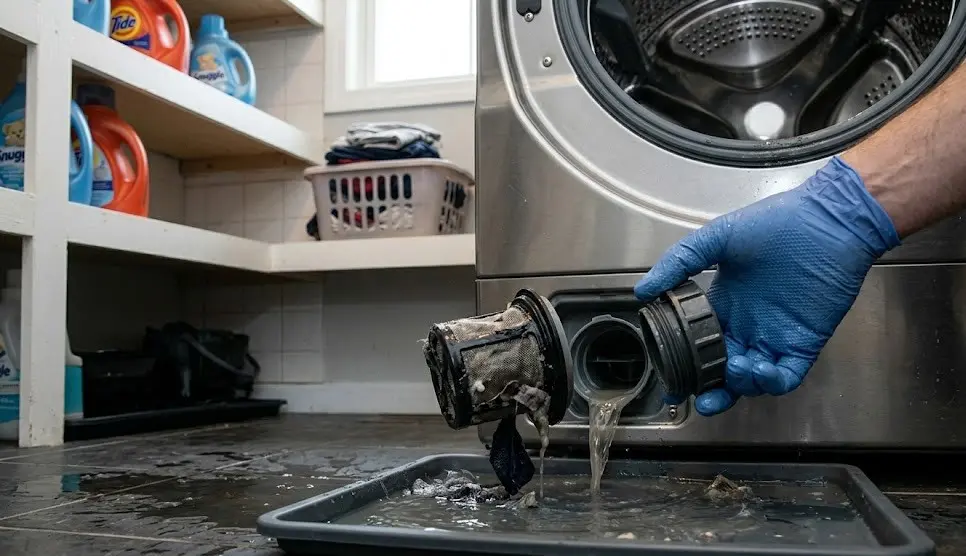
This is the single most frequent cause of washer drainage failure, and it is especially common in Abilene homes. The drain pump filter is designed to catch foreign objects before they damage the pump impeller. Over time, it traps lint, hair ties, coins, and small fabric pieces until the flow of water becomes completely restricted.
Front-load washers typically have an accessible filter panel near the bottom front of the machine. Top-load models sometimes hide the filter inside the agitator or behind a rear access panel. A fully clogged filter will not just slow drainage — it will stop it entirely, leaving your drum flooded at the end of every cycle.
If you have not cleaned the drain pump filter in the last three months, there is a very real chance this is your problem. Before opening it, have a shallow pan and old towels ready. There will be water.
2. Blocked or Kinked Drain Hose
The drain hose is the flexible tube that carries water from your washer drum out to the standpipe or laundry sink. If that hose gets kinked, crushed behind the machine, or internally blocked by a sock or debris, water has nowhere to go.
This is an easy one to check yourself. Pull the machine away from the wall slightly and look at how the hose runs. A sharp bend or a hose that has been pressed flat by the machine sitting against the wall is a common and completely fixable problem. If the hose is clear of kinks but still not draining, disconnect it and run water through it manually to check for internal blockages.
Also worth noting: Abilene plumbers sometimes see standpipe blockages that are entirely separate from the washer itself. If your laundry sink or standpipe is backed up, water has nowhere to drain regardless of how well your washer is functioning.
3. Failed Drain Pump
If the filter is clean and the hose is clear, the drain pump itself may have failed. The drain pump uses a motorized impeller to force water out of the drum and through the drain hose. When the pump motor burns out or the impeller breaks, the machine may hum during the drain cycle but produce no actual water movement.
You can often hear a failing pump before it quits entirely. A grinding or whirring noise during the drain portion of the cycle is a strong indicator that the pump is struggling. Once the pump motor fails completely, the machine will go silent during what should be the drain phase.
Replacing a drain pump is a mid-level repair that most experienced Abilene appliance technicians can complete in a single visit. Parts cost between $30 and $120 depending on your brand and model, with labor adding to the total.
4. Faulty Lid Switch or Door Lock
Top-load washers rely on a lid switch as a safety mechanism. If the machine detects that the lid is open — or if the switch malfunctions and falsely reads the lid as open — it will refuse to spin or drain. This is a surprisingly common cause of drainage failure that homeowners often mistake for a pump problem.
To test it simply, press down on the lid switch manually while the machine is in a drain cycle. If you hear a click and the machine responds, the switch mechanism is still functional. If pressing it changes nothing, the switch likely needs replacing.
Front-load washers use a door lock assembly instead. If the door lock fails mid-cycle, many machines will suspend all operations including drainage until the error is cleared. A door lock failure usually triggers an error code on digital display models.
5. Overloaded Drum or Unbalanced Load
Sometimes the cause has nothing to do with mechanical failure at all. An overloaded washer or a load that has shifted entirely to one side of the drum can prevent the spin cycle from completing properly. Without a full spin cycle, water does not drain completely, and you are left with soggy clothes and standing water.
If this is your situation, redistribute the load evenly, reduce the load size, and run a spin-only cycle to see if the machine clears the water. If it does, you have your answer.
6. Excess Detergent Buildup
Using too much detergent — or using standard detergent in a high-efficiency (HE) washer — creates excessive suds that can confuse the machine’s pressure sensor. The sensor may interpret high suds as a full drum and delay or halt draining accordingly. Over time, detergent residue also coats hoses and pump components, contributing to blockages.
Abilene homeowners with HE washers should always use detergent specifically labeled for HE machines, and should use it sparingly. A smaller amount than you think is typically enough.
7. Control Board or Pressure Switch Failure
Modern washing machines from brands like Samsung, LG, Whirlpool, and GE rely on electronic control boards and water level pressure switches to manage every stage of the wash cycle. If the pressure switch sends incorrect water level data to the control board, the machine may skip the drain cycle entirely, thinking the drum is already empty when it is not.
Control board failures and pressure switch issues are less common than pump or hose problems, but they do occur — particularly in older machines or those that have experienced electrical surges. These repairs typically require a diagnostic by a certified technician with the right tools to test sensor continuity and board function.
What You Can Check Before Calling a Technician
Not every drainage problem requires a professional visit. Here are the steps worth trying yourself, in order of simplest to most involved.
Step One: Run a drain and spin cycle with nothing in the drum.
Sometimes a load imbalance or a temporary sensor hiccup is all that happened. An empty drain/spin cycle often clears minor issues.
Step Two: Check the drain hose behind the machine.
Look for any visible kinks, sharp bends, or areas where the machine may be sitting on the hose. Straighten the hose if needed and ensure it is not inserted more than five inches into the standpipe, which can create a siphoning effect that blocks drainage.
Step Three: Clean the drain pump filter.
If your machine has an accessible filter (check your owner's manual), clear it out completely. Have a towel ready and open the cap slowly to control the water flow. Remove all debris, rinse the filter, and replace it securely.
Step Four: Check for error codes.
If your washer has a digital display and is showing a code like F9E1, E3, or a similar drain-related error, look up that code in your owner's manual. Error codes often point directly to the failing component, saving diagnostic time.
Step Five: Inspect the standpipe or laundry sink.
Pour a bucket of water into your standpipe or laundry sink. If it drains slowly or backs up, the problem may be in your home's plumbing rather than the washer itself.
If none of those steps resolve the issue, it is time to call a local Abilene appliance repair service.
How Abilene's Hard Water Makes This Problem Worse Over Time
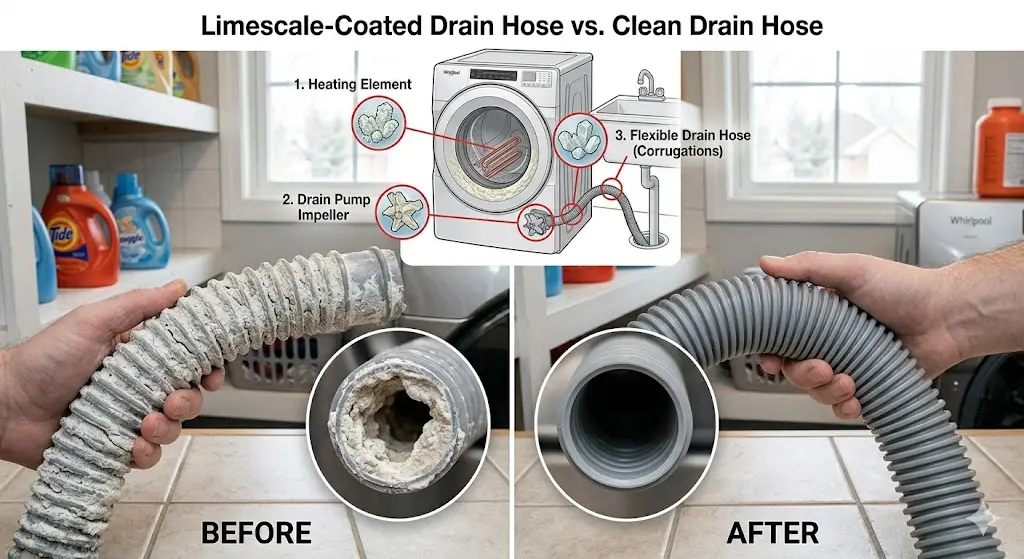
Abilene’s water is classified as hard to very hard, with elevated concentrations of calcium carbonate and magnesium. This is not a minor background factor — it actively shortens the service life of washing machine components that come into regular contact with water.
Limescale accumulates on the inside of drain hoses, reducing their interior diameter and restricting flow. It coats heating elements, damages rubber inlet hoses from the inside out, and leaves deposits inside the drain pump housing that make the pump work harder over time. Technicians working across Abilene regularly find that machines show accelerated wear compared to what the manufacturer’s expected lifespan suggests.
The practical implication for Abilene homeowners is that the standard maintenance schedule in your owner’s manual — often designed for moderate water conditions — is not aggressive enough for this region. Running a monthly cleaning cycle with white vinegar or a citric acid descaler, cleaning the filter every three months instead of every six, and inspecting hoses annually rather than every few years will meaningfully extend your machine’s lifespan.
Repair Costs for Washer Drainage Problems in Abilene, TX
Understanding what repairs actually cost helps you make a smarter decision about whether to fix or replace your machine.
For Abilene homeowners, typical washer repair costs break down roughly as follows based on current local market data:
Diagnostic fee:
Most Abilene appliance repair companies charge between $75 and $95 for a diagnostic visit. Some waive this fee if you proceed with the repair.
Drain pump filter cleaning:
If the only issue is a clogged filter that you cannot access yourself, a technician visit to clean and clear it typically runs $90 to $150 including the service call.
Drain hose replacement:
A new drain hose and installation generally costs $100 to $175 depending on the brand and model.
Drain pump replacement:
Parts range from $30 to $120 depending on the brand. With labor, total drain pump replacement in Abilene typically costs $150 to $350.
Lid switch replacement:
A straightforward repair that usually runs $100 to $200 including parts and labor.
Control board replacement:
The most expensive common repair, typically $300 to $700 or more depending on the make and model.
The general rule of thumb used by experienced repair technicians is this: if the repair cost exceeds 50% of the cost of a new equivalent washer, and the machine is more than halfway through its expected lifespan of 10 to 13 years, replacement is usually the smarter financial decision.
Which Washer Brands Are Most Common in Abilene Homes?
Abilene appliance repair technicians report seeing a fairly predictable mix of brands. Whirlpool and Maytag remain the most common across older and newer homes alike, with GE and Kenmore also showing up frequently in established neighborhoods. Over the past several years, Samsung and LG front-load and high-efficiency models have become increasingly common, particularly in newer construction around Wylie and North Abilene.
Each brand has its own known failure points. Whirlpool and Maytag top-load models frequently have lid switch issues. Samsung front-loaders are known for drain pump failures, particularly in areas with hard water. LG models with direct-drive motors tend to last well but can develop control board and pressure switch issues as they age.
Regardless of brand, Abilene’s water conditions affect every machine. A well-maintained Whirlpool will outlast a neglected LG, and vice versa.
When to Call a Local Abilene Appliance Repair Technician
Call a professional if:
Your washer is displaying error codes you cannot resolve through a reset or basic troubleshooting.
You have cleaned the filter and checked the hose, but the machine still refuses to drain.
You hear grinding, humming, or no sound at all during the drain portion of the cycle — these are pump failure indicators.
The machine is leaking water from the pump area, which suggests the pump housing has cracked and needs immediate attention to prevent floor damage.
Your washer is a front-load model and you are uncomfortable accessing internal components — front-loaders have more complex drainage systems than top-loaders and are worth having a professional diagnose.
The problem is intermittent, draining on some cycles but not others — intermittent faults are notoriously difficult to trace without proper diagnostic tools.
Local Abilene repair providers typically offer same-day service for washer drainage issues. Given that most drainage repairs can be completed in under two hours, scheduling promptly prevents the problem from worsening and avoids any risk of water damage to your laundry room floor.
Washer Maintenance Tips Specific to Abilene Homes
Given the hard water conditions and heavy usage patterns typical in the Big Country, these maintenance habits will extend your washer’s service life significantly:
Run a monthly cleaning cycle using white vinegar or a commercially available washing machine cleaner. This dissolves mineral deposits before they have a chance to accumulate into blockages.
Clean the drain pump filter every three months. Set a recurring calendar reminder — it takes less than ten minutes and prevents the most common drainage failure.
Always use HE detergent in HE washers, and use less than the label suggests. Abilene’s water conditions make over-sudsing a bigger issue than in softer-water cities.
After every wash cycle, leave the washer door or lid open for at least 30 minutes. This prevents mold and mildew buildup inside the drum and door seal — a particular problem with front-load washers.
Have your inlet hoses inspected annually. Hard water wears rubber hoses from the inside, and a burst inlet hose can cause significant water damage before you notice.
Do not overload. Running consistently overloaded cycles stresses the motor, pump, and bearings simultaneously.
Keep the machine level. An unlevel washer vibrates excessively during spin cycles, accelerating wear on the bearings and suspension rods.
Frequently Asked Questions
How do I know if my washer has a drainage problem or a plumbing problem?
Pour water directly into your laundry standpipe or sink. If that water drains slowly or backs up, the issue is in your home’s plumbing, not the washer. If the standpipe drains freely, the problem is inside the machine.
Can I use my washer if it is not draining?
You should not continue running a washer that fails to drain. Running additional cycles without resolving the drainage problem puts extra strain on the pump motor, which can turn a minor clog into a full pump failure. It also risks overflow and water damage to your laundry room.
How long does washer repair take in Abilene?
Most drainage-related washer repairs in Abilene are completed during a single visit of one to two hours. Same-day appointments are widely available from local providers.
Does hard water cause washer problems in Abilene?
Yes, significantly. Abilene’s hard water deposits limescale inside drain hoses, on pump components, and on heating elements faster than the manufacturer’s maintenance schedule accounts for. Regular descaling and filter cleaning are essential in this region.
Is it worth repairing a washing machine that is not draining?
In most cases, yes — particularly if the machine is under ten years old and the repair involves the pump, hose, or filter rather than the control board. Get a diagnostic first, then compare the repair cost against 50% of what a comparable new machine would cost.