
Dishwasher Not Cleaning Dishes Properly in Abilene? Here Is Why It Happens and How to Fix It
If your dishwasher is not cleaning dishes properly in Abilene, the most likely causes are clogged spray arms, a dirty filter recirculating grease and food debris, or mineral buildup from Abilene’s notoriously hard water reducing water pressure and blocking the inlet valve. In many cases you can resolve the issue with a few targeted troubleshooting steps. But when the problem keeps coming back, or when the cleaning cycles suddenly get worse after working fine for months, a professional appliance repair technician can diagnose and fix the root cause the same day. This guide walks through every common cause, what to look for, and when it makes sense to call for help.
Why Your Dishwasher Is Not Cleaning Dishes Properly
A dishwasher cleans dishes through a combination of hot water pressure, detergent action, and heat. When any one of those three elements is compromised, you end up opening the door to dishes that still have food stuck on them, cloudy glassware, or a greasy film that no amount of re-washing seems to fix.
The tricky part is that the same symptom can have five different causes. Cloudy glasses, for example, could point to hard water deposits, the wrong detergent, a failing heating element, a clogged spray arm, or a detergent dispenser that is not opening at the right moment in the cycle. Knowing which one applies to your situation saves you time and money.
A malfunctioning refrigerator or washer can disrupt your routine, so professional same day appliance repair services help restore comfort quickly.
Here is the short version of what typically goes wrong:
Spray arms
get clogged with mineral scale or food debris and lose water pressure
The filter
fills up with grease and food particles and starts recirculating dirty water
Hard water
deposits coat the interior, spray arms, and heating element over time
The water inlet valve
becomes partially blocked, reducing the amount of water entering the machine
The heating element
fails to reach the proper temperature, leaving detergent partially undissolved
The detergent dispenser
ticks shut and the soap never reaches the load
Water pressure
from your home supply drops below the level the machine needs to operate properly
Overloading
blocks the spray arms from rotating freely
Abilene's Hard Water Problem and Your Dishwasher
The water comes from O.H. Ivie Reservoir through the Hargesheimer Water Treatment Plant. As it travels through West Texas limestone and gypsum formations before reaching that reservoir, it picks up heavy concentrations of calcium and magnesium. By the time that water flows into your dishwasher, it is carrying a mineral load that most appliances in other parts of the country never have to deal with.
What that means practically is this: every wash cycle deposits a thin layer of calcium carbonate on the interior walls, spray arm nozzles, heating element, and water inlet screen of your dishwasher. Over weeks and months those layers build up. Spray arm holes that were originally 3 millimeters across can narrow to a fraction of that, cutting water pressure inside the machine dramatically. The heating element gets coated in limescale and takes longer to reach temperature, or stops reaching it altogether. And your dishes come out with that chalky white film that no amount of extra detergent seems to fix.
This is not a defect in your machine. It is the predictable result of running hard water appliances in a hard water city without a maintenance routine designed for those conditions.
The good news: hard water damage is largely preventable, and the damage that has already built up is usually reversible with a proper descaling treatment.
The Most Common Dishwasher Cleaning Problems in Abilene Homes
1. Clogged or Damaged Spray Arms
The spray arms are the rotating components inside your dishwasher that distribute hot water across your dishes during a wash cycle. Most machines have two, sometimes three: one at the bottom, one in the middle, and sometimes one mounted just below the top rack.
Each arm has a series of small nozzle holes that jet water at different angles. When those nozzles get blocked, whether by food debris, mineral scale, or a combination of both, water pressure inside the machine drops and certain areas of the load never get reached properly. You will often notice a pattern: dishes on one side or one rack come out clean while the other side consistently has food left on it. That is almost always a spray arm problem.
Checking the spray arms yourself is straightforward. Remove them from the machine (most just pull straight off or unscrew counterclockwise), hold them up to the light, and look through the holes. If you can see blockage, soak the arms in white vinegar for 30 to 60 minutes, then use a toothpick or thin wire to clear each nozzle. Rinse and reinstall.
If the arms are cracked or warped, or if they wobble and do not spin freely when replaced, the arms themselves need to be replaced. A technician can identify the right part for your specific brand and have new arms installed within a single visit.
2. A Dirty or Clogged Dishwasher Filter
Most modern dishwashers, including popular brands like Bosch, Whirlpool, Samsung, LG, and KitchenAid, use a manual filter rather than a self-cleaning food grinder. This filter sits at the bottom of the dishwasher tub, usually under the lower spray arm, and traps food particles so they do not recirculate onto your dishes.
The problem is that most homeowners do not know the filter exists until something goes wrong. When the filter gets full of grease and food debris, the machine starts washing your dishes in water that is already dirty. You end up with gritty residue on dishes, a musty smell coming from the machine, and a general decline in cleaning performance that feels like it appeared out of nowhere.
In Abilene, filters tend to get clogged faster than manufacturers anticipate because the hard water causes food particles to bind together and stick to the filter mesh. Cleaning the filter every two weeks is a reasonable schedule for most households here.
To clean it: remove the lower rack, unscrew the cylindrical filter by rotating it counterclockwise, lift out the flat mesh screen beneath it, and rinse both pieces under warm running water. Use a soft brush or old toothbrush to scrub away any stubborn residue. Reinstall and run a short cycle.
3. Water Inlet Valve Failure
The water inlet valve is an electrically controlled solenoid valve that opens to let water into the dishwasher at the start of each cycle. When it functions properly, the tub fills to the correct level and the pump circulates that water with enough pressure to clean your dishes effectively.
When the inlet valve begins to fail or gets clogged with mineral scale at the inlet screen, the tub underfills. The machine still runs through its cycle, but with less water than it needs. The result looks like poor cleaning, but the real issue is that the spray arms never had enough water to work with in the first place.
Signs of a failing or partially blocked water inlet valve include:
- Dishes in the back corners and upper edges of racks consistently not getting clean
- A wash cycle that sounds unusually quiet, since there is less water moving through the pump
- The machine running longer than normal as it tries to compensate for low water level
- Visible calcium deposits around the connection point at the back of the machine
Clearing the filter screen on the inlet valve is sometimes enough to restore proper flow. But if the valve itself has failed electrically or the solenoid is stuck, replacement is the correct fix. This is a repair that most technicians complete within an hour.
4. Heating Element Issues
Your dishwasher’s heating element serves two purposes. First, it heats the water during the wash cycle to a temperature high enough for the detergent enzymes to activate properly, typically between 120 and 150 degrees Fahrenheit. Second, it heats the air during the dry cycle to help moisture evaporate off your dishes.
When the heating element is coated in limescale, it takes significantly longer to bring water to the right temperature, and in severe cases it never gets there. Detergent that does not dissolve properly leaves a cloudy residue on everything. Dishes come out wet because the drying phase is also compromised. And if the element fails completely, you will notice the water stays cool and detergent tablets drop to the bottom of the tub undissolved.
Testing a heating element requires a multimeter to check for continuity. If it reads open (no continuity), the element is burned out and needs replacement. If it reads correctly but the machine still runs cool, the thermostat or control board that signals the element to activate may be the actual fault.
5. Detergent Dispenser Problems
The detergent dispenser door is spring-loaded and programmed to pop open at a specific point in the wash cycle, usually during the main wash after a pre-rinse. If the door fails to open, either because the spring is broken, the latch is sticky with residue, or the bi-metal actuator that triggers it has failed, the detergent never dissolves into the wash water.
You can usually confirm a dispenser problem by checking whether there is a detergent tab or powder sitting at the bottom of the tub after a completed cycle. If the dispenser failed to open, the detergent will have fallen out during the cycle but not dissolved at the right time.
Also check that you are using the right type of detergent. Liquid dish soap (hand-washing soap) should never go in a dishwasher, as it creates excessive suds that actually prevent the machine from cleaning properly and can damage the pump. Use dishwasher-specific pods, tablets, or powder, and avoid gel detergents in Abilene’s hard water since they tend to underperform compared to powder or enzyme-based tablets.

Signs Your Dishwasher Needs Professional Repair
Not every dishwasher problem can be solved with a filter cleaning or a vinegar rinse. These are the signs that point to an internal component failure that requires a trained technician:
White film that keeps coming back after cleaning.
If you clean the filter, descale the interior, and adjust your detergent, and the dishes still come out chalky within a few cycles, the problem may be inside the pump or circulation system rather than surface-level buildup.
Standing water at the bottom after a cycle.
Water that does not drain completely usually points to a clogged drain hose, a blocked drain pump, or a failing pump motor. Left unresolved, this water becomes a breeding ground for bacteria and makes the odor problem dramatically worse.
Grinding, banging, or rattling sounds during a cycle.
These noises typically come from debris caught in the pump impeller, worn bearings on the wash arm assembly, or dishes that are hitting the spray arms. If repositioning the dishes and removing obvious debris does not fix it, have a technician check the pump.
Error codes on the display.
Modern dishwashers communicate faults through error codes. Bosch, Whirlpool, and Samsung all use different code systems, but most error codes point to specific component failures that require diagnostic tools to properly address.
Cycles that stop mid-run.
A cycle that starts normally and then stops partway through often indicates a control board fault, a door latch that is not registering as closed, or a thermal fuse that is tripping due to overheating.
Leaking around the door.
A failing door gasket or a warped door latch allows hot water to escape during the cycle, which reduces pressure inside the machine and makes a mess on your kitchen floor.
If you are seeing any of these issues, a same-day appliance repair call in Abilene can get the machine diagnosed and in most cases fully repaired before end of day.
DIY Troubleshooting Steps to Try First
Before calling a technician, work through these steps in order. In many cases, one of these fixes is all you need.
Step 1: Clean the filter.
This is the single most overlooked maintenance task on modern dishwashers and the most common cause of cleaning problems. Refer to the filter cleaning instructions above.
Step 2: Inspect and clear the spray arms.
Remove both spray arms, soak in white vinegar for at least 30 minutes, clear all nozzle holes, and reinstall.
Step 3: Run a dishwasher cleaning cycle.
Place a bowl with two cups of white vinegar on the bottom rack and run a hot wash cycle with no dishes and no detergent. Follow that with a cycle after sprinkling a cup of baking soda on the bottom of the tub. This combination breaks down limescale and deodorizes the interior.
Step 4: Check your water temperature.
Run your kitchen hot water tap for 60 seconds before starting the dishwasher. This clears the cold water sitting in the supply line and ensures the machine starts filling with properly hot water. Your water heater should be set to at least 120 degrees Fahrenheit.
Step 5: Evaluate your detergent.
Switch to a high-quality enzyme-based dishwasher tablet. In Abilene's hard water, brands that include a built-in rinse aid and hard water formula perform significantly better. Also check that you are using a rinse aid in the dispenser, as this dramatically reduces spots and film on glassware.
Step 6: Load the dishwasher correctly.
Dishes angled inward, pots facing down, and nothing blocking the spray arms from rotating. Overloading is one of the most common causes of poor cleaning performance that has nothing to do with the machine itself.
If you have worked through all six steps and still have a problem, it is time to call in a professional.
Hard Water Maintenance for Abilene Dishwashers
Given Abilene’s water quality, standard dishwasher maintenance schedules are not enough. Here is a maintenance routine built specifically for homes in this area:
Every two weeks:
Clean the filter and wipe down the door gasket with a damp cloth.
Monthly:
Run a full descaling cycle using white vinegar. Check the spray arm nozzles for scale buildup and clear as needed.
Every three months:
Inspect the interior walls and heating element for visible white scale. Use a commercial dishwasher descaler product (available at most hardware stores) if buildup is significant.
Annually:
Have a technician inspect the inlet valve, circulation pump, and heating element for scale damage and wear. This is especially important for machines that are five years or older.
Year-round:
Use a rinse aid consistently, as it helps water sheet off dishes rather than bead and dry into spots. In hard water cities like Abilene, skipping rinse aid leads to fast-deteriorating glass clarity.
If scaling is a chronic problem in your home, consider a whole-house water softener. For dishwashers specifically, a water softener eliminates the single largest factor shortening appliance lifespan in West Texas.
When to Repair vs. Replace Your Dishwasher
This is the question every homeowner eventually faces. The general rule used by appliance repair professionals is the 50 percent rule: if the repair cost exceeds 50 percent of the cost of a comparable new machine, replacement starts to make more financial sense than repair.
Repair makes sense when:
- The machine is less than 8 years old
- The problem is a single component (spray arm, inlet valve, heating element, detergent dispenser)
- The machine is a premium brand like Bosch or Miele with a replacement cost well above $800
- The machine has not had multiple component failures in the past two years
Replacement makes more sense when:
- The machine is 10 or more years old
- You have already repaired multiple components in the past two to three years
- The control board or motor has failed, and the repair cost approaches or exceeds half the cost of a new unit
- The door has structural damage or the tub is cracked
A reputable local technician will give you an honest assessment after the diagnostic and tell you straightforwardly whether repair is the smart call. If a company recommends expensive repair on a 12-year-old machine with a broken control board and a history of issues, get a second opinion.

When to Call a Local Appliance Repair Technician in Abilene
You have cleaned the filter, cleared the spray arms, run a descaling cycle, checked your detergent, and the dishes are still coming out dirty. That is the point where professional diagnosis saves you both time and money.
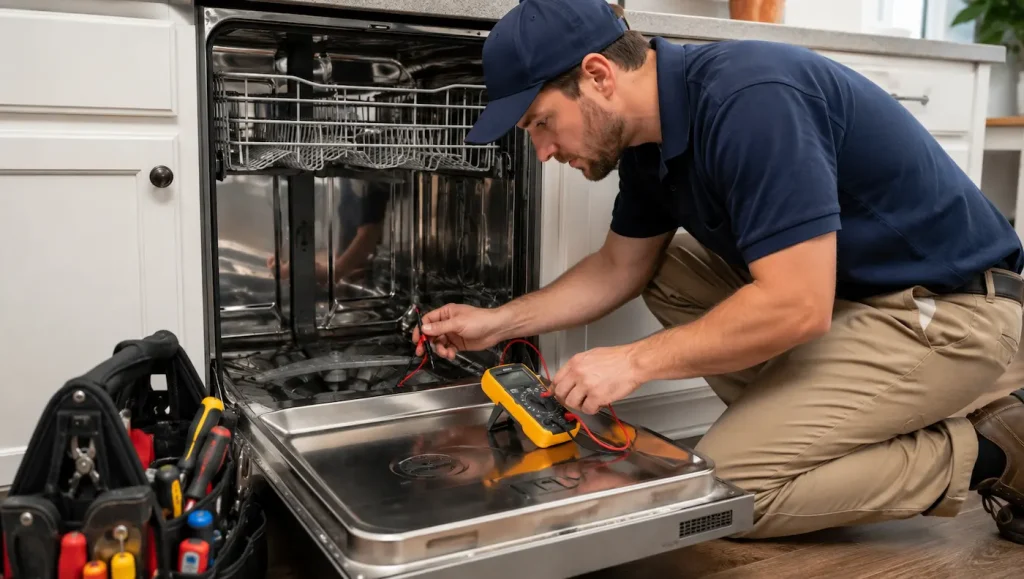
A trained technician can check water pressure entering the machine, test the heating element for correct resistance values, verify the inlet valve is functioning properly, run a diagnostic cycle to pull any stored error codes, and physically inspect the pump and motor. Most of these checks cannot be done accurately without the right diagnostic tools.
What to look for in a local Abilene appliance repair company:
- TDLR-licensed technicians (this is the Texas Department of Licensing and Regulation credential that certifies appliance technicians in the state)
- Same-day availability, because a dishwasher that is not working means dishes piling up and everyone in the house is inconvenienced
- Flat-rate or transparent diagnostic fees so you know the cost before any work begins
- A parts and labor warranty on completed repairs
- Experience with your specific brand, whether that is Whirlpool, Bosch, LG, Samsung, Maytag, GE, or KitchenAid
Preventative Maintenance Tips to Keep Your Dishwasher Running Longer
Scrape dishes before loading, but skip the pre-rinse.
Modern dishwashers are designed for lightly soiled dishes. The sensors in many machines actually calibrate the cycle based on how dirty the water becomes, so pre-rinsing can cause the machine to run a lighter cycle than your dishes actually need. Scrape solids off but leave residue.
Run the dishwasher on a hot wash setting regularly.
Short or eco cycles do not reach the temperatures needed to prevent bacterial buildup and grease accumulation in the sump area.
Keep the door gasket clean.
Wipe the rubber seal around the door with a damp cloth weekly. Mold and mildew in the gasket creates odor and can affect the door seal, leading to leaks over time.
Never overload the machine.
The single biggest cause of cleaning problems that have nothing to do with mechanical failure. Dishes need water to reach every surface. Pack too many in and the physics simply do not work.
Use a rinse aid every cycle.
In Abilene's hard water, this is not optional if you want spot-free glassware.
Leave the door cracked after a cycle.
Allowing the interior to air dry after a cycle reduces the mold and mildew buildup that causes odors and can contaminate your next wash.
Frequently Asked Questions
Why is my dishwasher leaving food on dishes?
The most common reasons are a clogged spray arm that cannot distribute water evenly, a dirty filter recirculating food-laden water, or overloading that prevents water from reaching all surfaces. Start by cleaning the filter and spray arms. If the problem continues after that, a partially blocked water inlet valve or failing circulation pump may be reducing water pressure inside the machine.
Why are my dishes cloudy after washing?
Cloudy dishes in Abilene almost always come down to hard water mineral deposits. The calcium in the water leaves a white film as it dries on glass surfaces. Using a quality rinse aid every cycle, switching to an enzyme-based dishwasher tablet formulated for hard water, and running a monthly vinegar descaling cycle can significantly reduce this problem. If the cloudiness is already etched into the glass rather than sitting on the surface, unfortunately that damage is permanent, but you can prevent it from getting worse.
Can hard water affect dishwasher performance?
Yes, significantly. Abilene’s water measures around 33 grains per gallon of hardness, well into the range where scale buildup becomes a real maintenance concern. Mineral deposits narrow the spray arm nozzles and reduce water pressure, coat the heating element and slow its ability to heat water, clog the inlet valve screen, and leave white deposits on every dish surface. Hard water is the most consistently underappreciated cause of declining dishwasher performance in Abilene homes.
Why is my dishwasher not spraying water properly?
If you open the machine mid-cycle or find the spray arms are not rotating after a cycle, the most likely causes are a blockage in the spray arm nozzles, a failing circulation pump that is not building enough pressure to drive water through the arms, or an inlet valve problem causing the tub to underfill. Check the spray arms first, as they are easy to remove and clean. If they are clear and the problem continues, a technician should check pump pressure and inlet valve flow.
Is it worth repairing a dishwasher?
In most cases, yes, especially if the machine is less than 8 years old and the problem is a single component. A repair that costs $150 to $250 on a 5-year-old Bosch or Whirlpool is almost always a better financial decision than buying a new machine. If the machine is over 10 years old and has had multiple repairs, or if the motor or control board has failed on a low-end model, replacement often makes more sense. Ask your technician directly: a reputable one will tell you honestly which way the math goes for your specific situation.